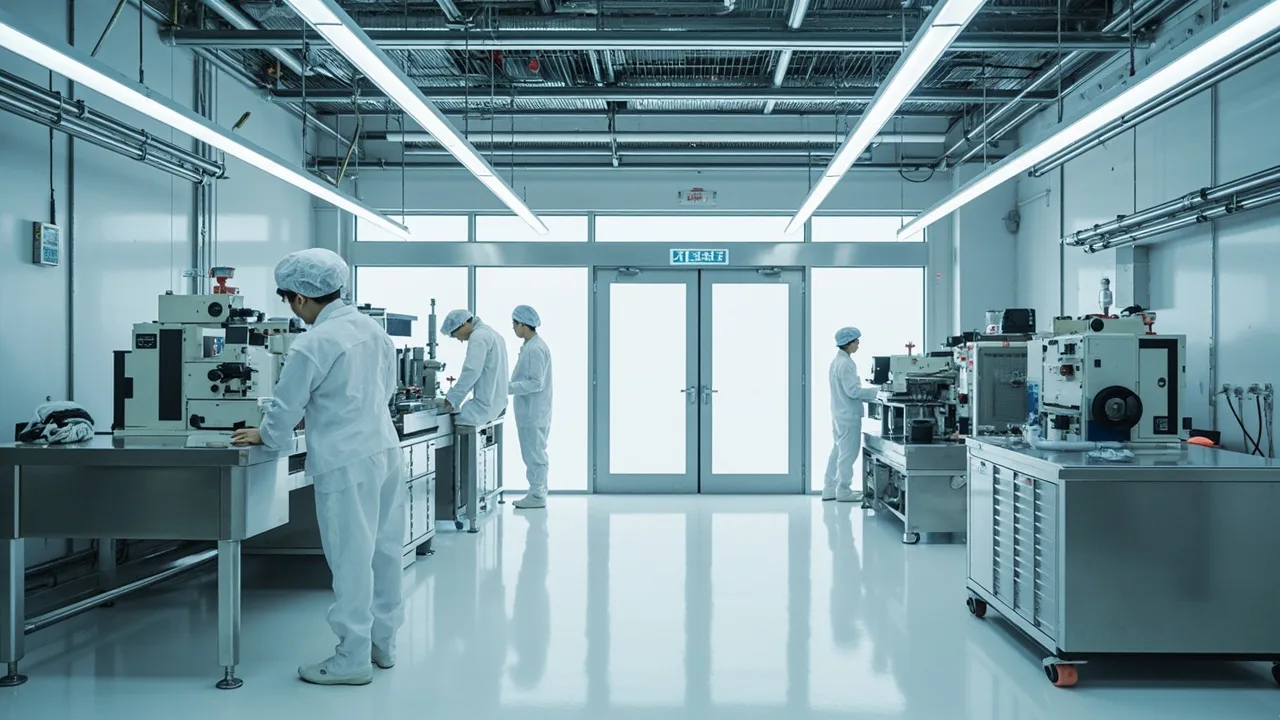
Semiconductor Today reported on 19 November 2026 that Penn State University and the Midwest Microelectronics Consortium (MMEC) held a ribbon-cutting ceremony at the Millennium Science Complex (MSC), opening new advanced semiconductor research capabilities whose newly installed equipment will support research aimed at moving promising materials and technologies closer to manufacturing.
The equipment is housed in Materials Research Institute (MRI) facilities at the MSC, supported by $4.3m in infrastructure funding, in-kind support through Penn State's MMEC membership and Penn State co-investment. The MMEC funding is part of the federal Microelectronics Commons effort established under the CHIPS and Science Act.
New capabilities
- A metal-organic chemical vapor deposition (MOCVD) system for growing semiconductor films;
- An atomic force microscope (AFM) able to map and characterise materials across wafers;
- A metal evaporation system for creating the electrical contacts needed to turn semiconductor materials into working devices.
MMEC leaders said the systems were selected partly for compatibility with industry processes, helping reduce the gap between university research and commercial fabrication.
Research focus and access
Joan Redwing, distinguished professor of materials science and electrical engineering and associate director of the 2D Crystal Consortium Materials Innovation Platform, said the infrastructure will let researchers scale laboratory-scale processes and materials up to larger wafer sizes and advance the technology toward applications. Professor Suzanne Mohney, who oversaw installation of the metal deposition system, said the equipment adds capabilities for producing high-purity films and integrating materials under tightly controlled conditions.
Two-dimensional semiconductors are one research focus, as conventional silicon approaches physical limits, alongside wide- and ultrawide-bandgap materials such as gallium nitride and gallium oxide for power electronics. The facilities will also be available to outside users and MMEC partners, and will provide workforce development for students and postdoctoral researchers. MMEC has nearly 600 members spanning academia, industry and government, and CEO Matt Casto said the infrastructure investment aims to lower barriers to access and capture innovation within a domestic ecosystem.