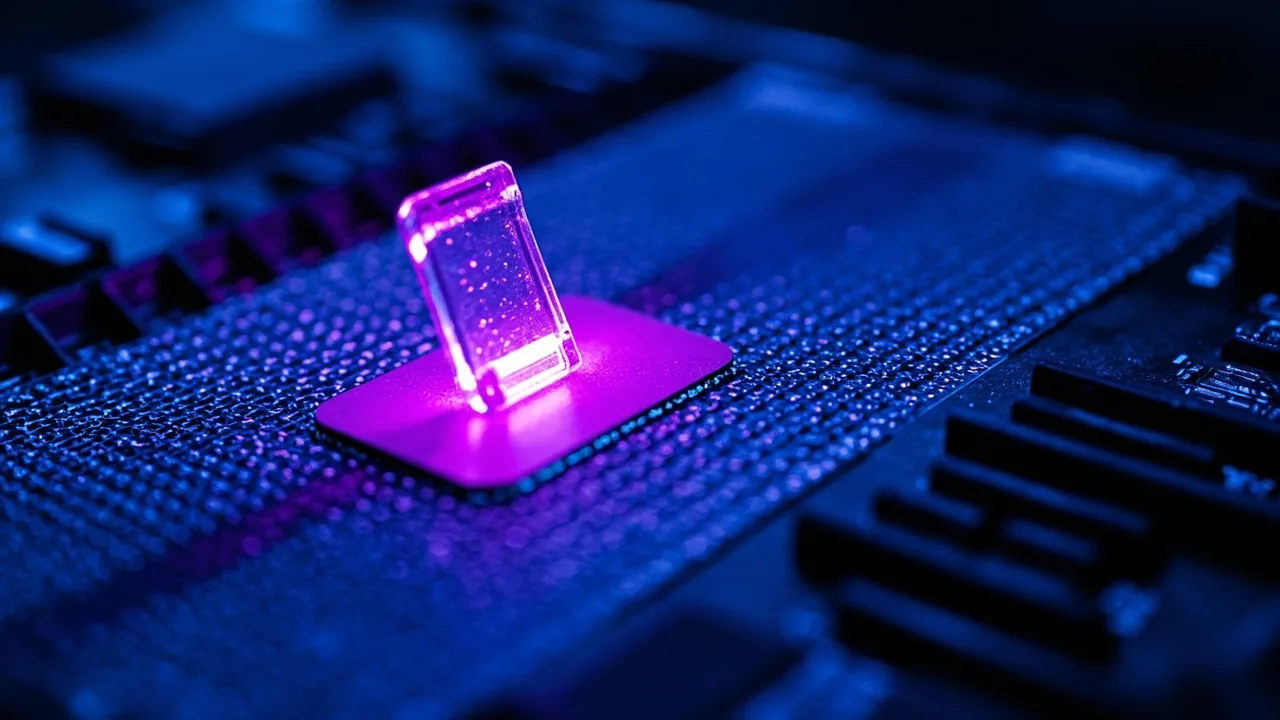
Japan's National Institute of Information and Communications Technology (NICT) has reported 275nm deep-ultraviolet (DUV) top-emitting AlGaN LEDs with a peak external quantum efficiency (EQE) of 7.5% at 10mA and a wall-plug efficiency (WPE) of 6.5% at 7mA. The results were published online in ACS Photonics on 21 October 2026 and reported by Semiconductor Today.
Conventional AlGaN DUV LEDs use a final p-GaN layer on the p-side to supply holes, but p-GaN strongly absorbs DUV light, so output largely leaves through the substrate, requiring the chip to be flipped onto a submount. The top-emitting configuration removes that chip-transfer step, simplifying fabrication, and lets light from the AlGaN active region exit directly.
The devices use a ring mesa (200μm inner, 600μm outer diameter) with concentric 2μm-wide metal p-electrodes at 10μm pitch covering about one-fifth of the mesa. Regions between electrodes were etched to p-AlGaN and filled with nano-structured hafnium dioxide (HfO2), deposited by RF magnetron sputtering and patterned into truncated cones to enlarge the escape cone and reduce Fresnel reflection. The n-electrode sits at the centre of the ring, an aluminium reflector was deposited on the sapphire back, and the LEDs were encapsulated as 1mm x 1mm chips.
- Light-intensity enhancement over the same structure in flip-chip form was 1.35x below 50mA, and 1.13x even without the truncated-cone texturing.
- At 200mA the enhancement reached 2.1x, attributed to reduced efficiency droop; pulsed-injection comparisons point to lower self-heating.
- Devices with HfO2 nanostructuring delivered 38mW at 200mA, with strongest emission at about 40° from normal.
For heat management, the full 1mm2 substrate contacts the TO-can, versus only the 0.06mm2 n- and p-pads on the submount in the flip-chip case. The researchers describe the work as the first demonstration of top-emitting AlGaN-based DUV LEDs, confirming feasibility and pointing to a path toward low-cost, high-efficiency devices.