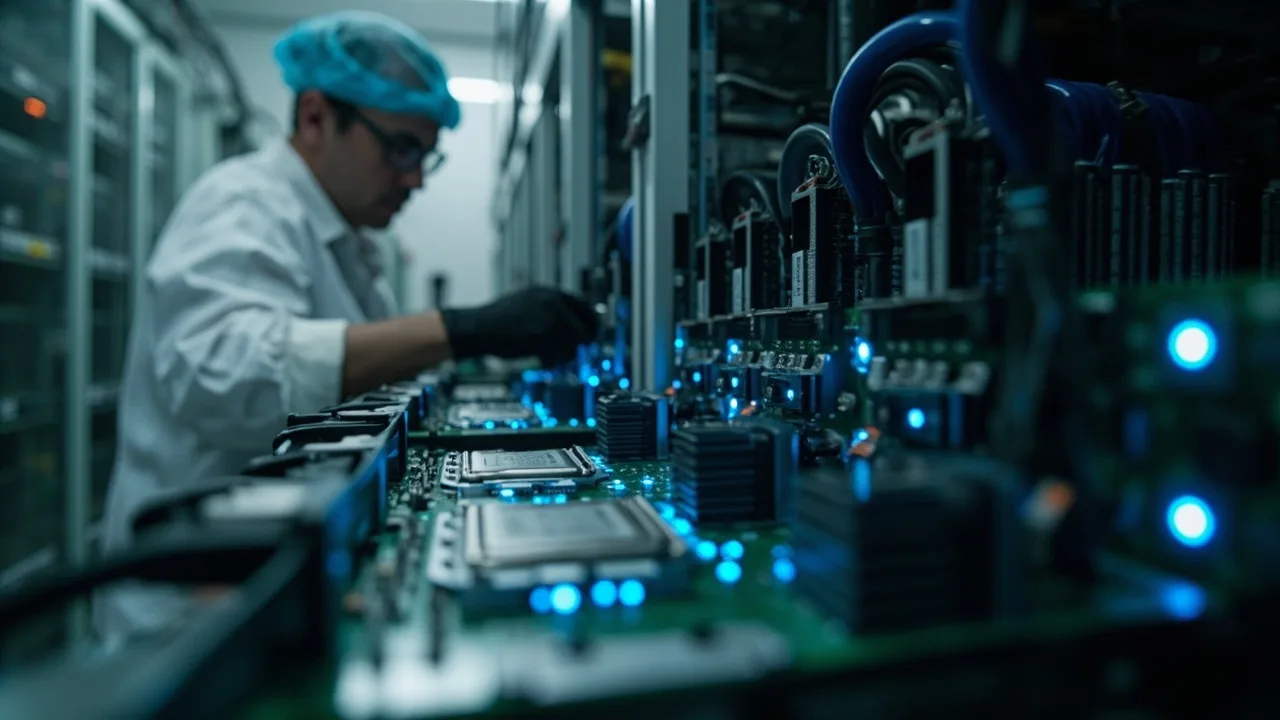
AMD said on Nov. 9, 2026 that its 5th Gen EPYC processors power the host infrastructure for Google Cloud TPU 8tx, which AMD describes as the first cloud TPU system to deliver hardware-enforced confidential computing. (Source: AMD press release)
According to AMD, the EPYC CPUs in TPU 8tx systems manage workload orchestration, data preparation and high-throughput communication with the TPU accelerators, and the system uses AMD Secure Encrypted Virtualization (SEV) capabilities, together with the TPU, to extend confidential-computing protection beyond the CPU to attached accelerators. Verifying an accelerator's identity and security configuration before granting it direct access to protected memory helps keep prompts, model weights and intermediate data encrypted in CPU memory and in transit between host and accelerators, with hardware isolation during accelerator execution, AMD says. AMD notes that Infinity Guard features vary by EPYC processor generation and series and must be enabled by server OEMs or cloud service providers to operate. AMD says the combination targets inference, fine-tuning and reinforcement-learning workloads.
AMD also says EPYC is the host CPU of choice for more than 10 leading hyperscalers and frontier AI labs, spanning GPUs and custom AI accelerator ASICs; AMD did not name the customers or provide supporting data, and the claim was not independently verified. Collaboration spans multiple EPYC generations supporting general-purpose, compute-intensive, storage-intensive and accelerated workloads leading up to the current C4D, N4D, H4D, Z4D and G4 VM families, according to the release. AMD SEV technologies also protect workloads across Google Cloud's confidential computing portfolio, including Confidential VMs, Confidential GKE, Confidential Space, Confidential Managed Service for Apache Spark and Confidential Dataflow, the release says.
The release provided no benchmarks, availability dates or pricing for TPU 8tx. In the release, Google Cloud said customers get silicon-level data protection alongside the low-latency performance needed for modern reasoning models.